 admin
admin 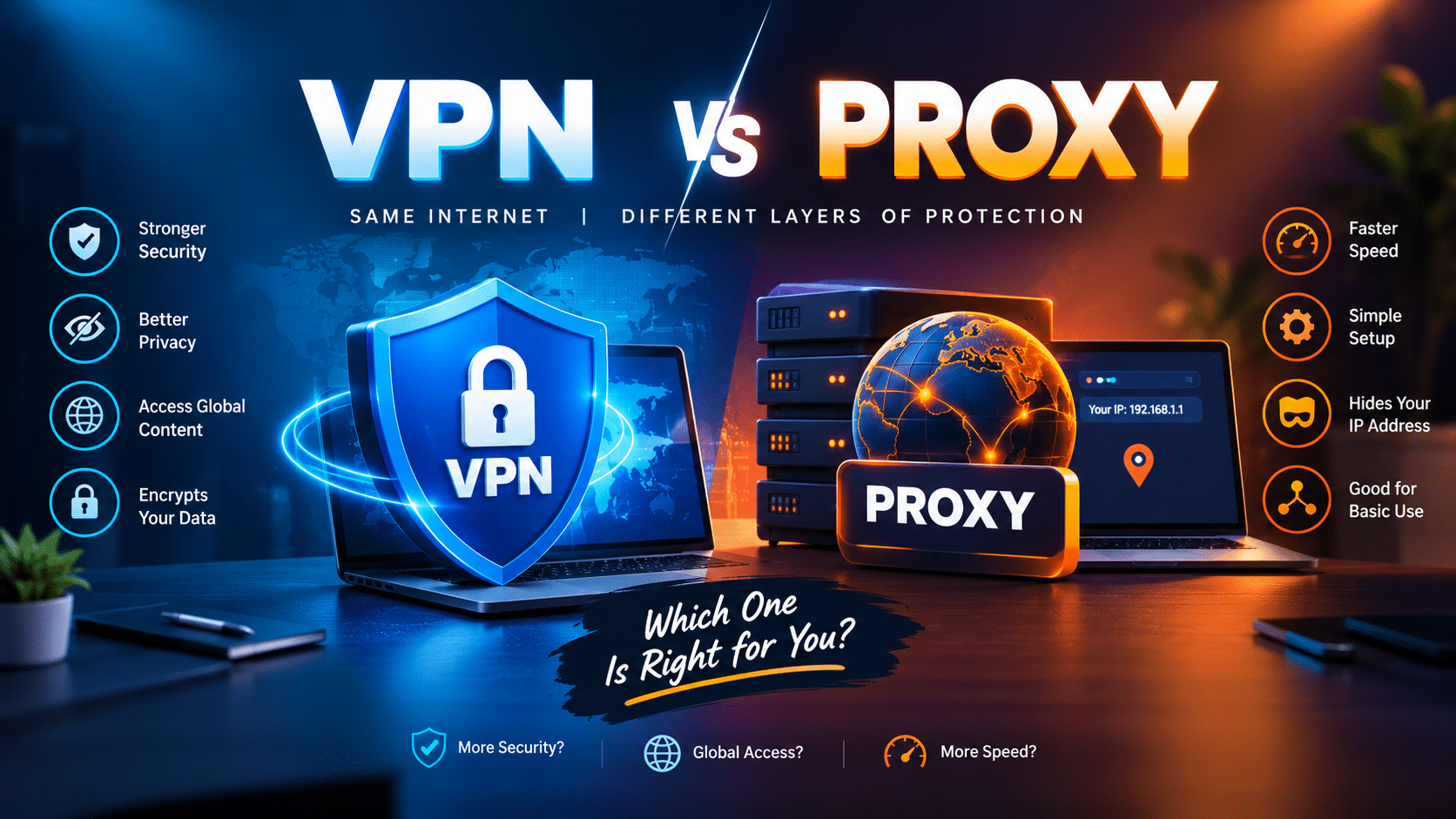
In today’s digital world, protecting your online privacy has become more important than ever. Whether you’re browsing the web, accessing restricted content, working remotely, or safeguarding sensitive information, you’ve likely come across two popular tools: VPNs and proxies.
Many people assume that a VPN and a proxy server are the same thing because both can hide your IP address and help you access geo-restricted content. However, there are significant differences between these technologies when it comes to security, encryption, privacy, speed, and overall functionality.
This guide explores VPN vs Proxy, explaining how each works, their advantages and disadvantages, and which option is best for different use cases.
What Is a VPN?
A Virtual Private Network (VPN) is a service that creates a secure, encrypted connection between your device and the internet. Instead of connecting directly to websites, your traffic is routed through a VPN server.
How a VPN Works
When you connect to a VPN:
- Your internet traffic is encrypted.
- Data travels through a secure VPN tunnel.
- Your real IP address is hidden.
- Websites see the VPN server’s IP address instead.
This process enhances privacy, security, and anonymity while browsing online.
Key Features of a VPN
- End-to-end encryption
- IP address masking
- Secure public Wi-Fi usage
- Protection from hackers
- Access to geo-blocked content
- Enhanced online privacy
What Is a Proxy Server?
A proxy server acts as an intermediary between your device and the internet. When you use a proxy, your requests pass through the proxy server before reaching the target website.
The website sees the proxy server’s IP address rather than your own.
How a Proxy Works
The process is relatively simple:
- You connect to a proxy server.
- The proxy forwards your request.
- The website sends data back to the proxy.
- The proxy delivers the information to you.
Unlike most VPN services, many proxies do not encrypt internet traffic.
Key Features of a Proxy Server
- IP address masking
- Faster setup
- Browser-specific configuration
- Geo-restriction bypass
- Traffic forwarding
Businesses that fail to monitor AI visibility may lose a large portion of their organic traffic in the future. AI search monitoring tools help companies stay competitive in the evolving digital landscape.
Some of the biggest reasons to use AI search monitoring tools include:
- Tracking AI-generated search visibility
- Monitoring conversational search performance
- Improving AI-focused SEO strategies
- Understanding user intent better
- Monitoring competitor performance
- Tracking AI citations and mentions
- Increasing brand authority
- Optimizing content for AI recommendations
These tools allow businesses to adapt their content strategies according to modern search trends and AI-driven search behavior.
VPN vs Proxy: Understanding the Core Difference
The primary difference between a VPN and a proxy is encryption.
A VPN encrypts all internet traffic, while most proxies simply reroute traffic without encryption.
For example, when users ask ChatGPT or Google AI Overviews a question, the AI may provide a summarized answer using information from trusted sources. Businesses want to know whether their website is included in those summaries.
AI search monitoring tools help businesses track:
- How often their brand appears
- Which keywords trigger AI visibility
- Which pages are cited by AI systems
- Which competitors dominate AI search
This information helps companies improve visibility and maintain strong online authority.
Feature | VPN | Proxy |
IP Masking | Yes | Yes |
Data Encryption | Yes | Usually No |
Security | High | Low |
Privacy Protection | Strong | Limited |
Device Coverage | Entire Device | Application or Browser |
Public Wi-Fi Protection | Yes | No |
Speed | Slightly Slower | Often Faster |
Cost | Usually Paid | Many Free Options |
VPN vs Proxy Security Comparison
VPN Security Benefits
One of the biggest advantages of a VPN is robust security.
VPNs use encryption protocols such as:
- OpenVPN
- WireGuard
- IKEv2
- IPSec
These protocols protect your data from:
- Hackers
- Cybercriminals
- Government surveillance
- ISP monitoring
- Data thieves
Proxy Security Limitations
Most proxy servers only change your IP address.
Without encryption:
- Data can be intercepted.
- Sensitive information may be exposed.
- Public Wi-Fi risks remain.
For users concerned about cybersecurity, VPNs generally provide much stronger protection.
AI search monitoring tools allow businesses to track:
- Competitor AI visibility
- AI-generated mentions
- Conversational search rankings
- Competitor content strategies
- Keyword performance comparison
This data helps marketers understand why competitors perform well and how to improve their own content strategies.
Businesses can identify:
- Which competitors dominate AI-generated results
- Which content formats perform best
- Which keywords drive AI visibility
- Which pages receive the most AI citations
This creates better opportunities for content improvement and SEO growth
VPN vs Proxy Privacy Differences
Privacy with a VPN
VPN services offer improved privacy by:
- Hiding your real IP address
- Encrypting browsing activity
- Preventing ISP tracking
- Reducing data collection
Many premium VPN providers also offer:
- No-log policies
- Kill switches
- DNS leak protection
Privacy with a Proxy
Proxy servers provide basic anonymity but do not guarantee privacy.
Potential issues include:
- Activity logging
- Lack of encryption
- DNS leaks
- Traffic monitoring
For serious privacy protection, VPN technology is usually the preferred solution.
AI search monitoring tools help businesses analyze different types of search intent, including:
- Informational intent
- Commercial intent
- Transactional intent
- Navigational intent
- Conversational intent
Understanding search intent helps businesses create content that matches what users actually want.
For example, conversational AI users often ask detailed questions such as:
- “What are the best AI search monitoring tools?”
- “Why use AI search monitoring tools for SEO?”
- “Which AI SEO tools improve brand visibility?”
AI monitoring platforms help businesses optimize content specifically for these conversational search patterns.
Types of Proxy Servers
Understanding different proxy server types helps clarify the proxy vs VPN debate.
HTTP Proxy
Designed for web browsing traffic.
Best for:
- Basic website access
- Bypassing simple restrictions
HTTPS Proxy
Offers limited encryption for browser traffic.
Best for:
- Secure website access
SOCKS5 Proxy
More versatile than HTTP proxies.
Supports:
- Streaming
- Gaming
- File sharing
- Torrent clients
Transparent Proxy
Used by organizations and networks.
Common uses:
- Content filtering
- Monitoring internet activity
AI search monitoring tools help track:
- AI citations
- Brand mentions
- Product mentions
- AI-generated recommendations
- Authority signals
Frequent AI citations improve online trust and strengthen brand authority.
Businesses that appear regularly inside AI-generated responses may gain:
- More traffic
- Better credibility
- Increased brand awareness
- Higher customer trust
This makes AI citation tracking extremely valuable for bloggers, publishers, e-commerce websites, and SaaS companies.
Types of VPN Services
Not all VPN services are identical.
Remote Access VPN
Used by individuals for secure internet access.
Ideal for:
- Remote workers
- Travelers
- Home users
Site-to-Site VPN
Connects entire business networks securely.
Ideal for:
- Enterprises
- Multi-location organizations
Mobile VPN
Designed for smartphones and tablets.
Provides:
- Secure browsing
- Safe mobile connections
These tools collect and process large amounts of search data to understand how AI systems interpret and recommend content.
Most AI search monitoring platforms provide features such as:
- Keyword visibility tracking
- Conversational search analysis
- AI mention monitoring
- Search intent analysis
- Competitor monitoring
- AI citation tracking
- AI-generated answer analysis
- SEO optimization recommendations
Some advanced tools even provide predictive analytics that help businesses identify future search trends before competitors.
Modern AI monitoring platforms continuously scan AI search engines and conversational systems to measure how websites perform inside generated answers.
VPN vs Proxy for Streaming
Many users compare VPNs and proxies for streaming services.
VPN for Streaming
Benefits include:
- Access to geo-restricted content
- Enhanced privacy
- ISP throttling prevention
- Secure streaming sessions
Proxy for Streaming
Benefits include:
- Faster connection speeds
- Lower latency
- Simple setup
However, many streaming platforms can detect and block proxy servers more easily than reputable VPN services.
Profound
Profound is one of the most advanced AI search monitoring tools available today. It is specifically designed for tracking visibility inside generative AI search systems.
Key features of Profound include:
- AI visibility tracking
- Conversational search monitoring
- AI citation analysis
- Competitor tracking
- Search intent insights
- AI-generated answer monitoring
Businesses use Profound to understand how their content appears inside ChatGPT, Gemini, and other AI platforms.
The platform is especially useful for:
- SaaS companies
- Publishers
- Enterprise brands
- SEO agencies
- Content marketers
Profound helps businesses improve AI discoverability and strengthen online authority.
Peec AI
Peec AI is another powerful AI search monitoring platform focused on AI-driven brand visibility and conversational search intelligence.
Important features include:
- AI brand monitoring
- AI-generated mention tracking
- Search trend analysis
- Conversational keyword tracking
- Competitor visibility analysis
- AI search reporting
Peec AI helps businesses identify which content types perform best inside AI-generated search results.
The platform is useful for companies wanting to improve:
- AI search rankings
- Brand authority
- Conversational SEO
- AI discoverability
Peec AI is becoming increasingly popular among modern digital marketers.
Semrush AI Toolkit
Semrush is already one of the world’s most popular SEO platforms, and its AI Toolkit now includes AI search monitoring capabilities.
The Semrush AI Toolkit offers:
- AI search tracking
- Keyword visibility monitoring
- Content optimization
- Competitor analysis
- AI Overview tracking
- Conversational SEO insights
Businesses use Semrush because it combines traditional SEO and AI-focused search analytics in one platform.
Advantages of Semrush include:
- Large keyword database
- Powerful reporting features
- Content optimization tools
- AI-driven SEO recommendations
It is ideal for bloggers, agencies, and e-commerce businesses.
VPN vs Proxy for Gaming
Online gamers often use VPNs and proxies for different reasons.
VPN Gaming Benefits
- Protection from DDoS attacks
- Secure connections
- Reduced ISP throttling
- Privacy protection
Proxy Gaming Benefits
- Lower latency in some cases
- Faster routing options
Gamers typically choose VPNs when security is a priority and proxies when speed is the main concern.
VPN vs Proxy for Business Use
Businesses frequently rely on VPN technology to protect company data.
Why Businesses Prefer VPNs
- Encrypted communication
- Secure remote access
- Compliance requirements
- Data protection
Business Proxy Use Cases
Organizations may use proxies for:
- Content filtering
- Traffic management
- Employee internet monitoring
- Caching frequently accessed websites
In enterprise environments, VPNs and proxies often work together rather than compete.
Advantages of Using a VPN
Strong Security
VPN encryption protects sensitive information.
Complete Device Protection
VPNs secure all internet traffic on the device.
Better Privacy
Online activities remain more private.
Safe Public Wi-Fi Usage
Ideal for airports, hotels, and cafes.
Access Restricted Content
Bypass geographic restrictions securely.
Advantages of Using a Proxy
Faster Performance
No encryption often means faster speeds.
Easy Configuration
Simple browser setup.
Lower Cost
Many proxy services are free.
Suitable for Simple Tasks
Good for basic IP masking and web browsing.
Disadvantages of VPNs
Despite their benefits, VPNs have some drawbacks.
Potential Speed Reduction
Encryption can slightly slow connections.
Subscription Costs
Quality VPN providers often require payment.
Server Congestion
Performance can vary depending on server load.
Disadvantages of Proxies
Proxy servers also have limitations.
Weak Security
Most proxies lack encryption.
Limited Privacy
Activity may still be tracked.
Application-Specific Coverage
Often only protects browser traffic.
Reliability Issues
Free proxies may be unstable or unsafe.
When Should You Use a VPN?
A VPN is typically the better option if you:
- Handle sensitive information
- Use public Wi-Fi frequently
- Need strong online privacy
- Want secure remote access
- Need encrypted internet traffic
- Work remotely
VPN solutions are designed for users who prioritize security and privacy.
When Should You Use a Proxy?
A proxy may be suitable if you:
- Need a quick IP address change
- Want basic anonymity
- Need browser-specific routing
- Are performing simple web tasks
- Prioritize speed over security
For low-risk activities, a proxy server can be sufficient.
VPN and Proxy Together: Is It Possible?
Yes, some advanced users combine VPN and proxy services.
Benefits may include:
- Additional anonymity layers
- Specialized routing
- Enhanced privacy controls
However, combining both can:
- Reduce speed
- Increase complexity
- Require technical expertise
Most users find that a quality VPN alone provides adequate protection.
Final Verdict: VPN vs Proxy
When comparing VPN vs Proxy, the best choice depends on your specific needs.
If your priority is security, privacy, encryption, and safe internet access, a VPN is generally the more comprehensive solution. It protects your data, hides your IP address, and secures all internet traffic across your device.
If you simply need basic IP masking, faster speeds, or access to restricted websites, a proxy server may be sufficient for lightweight tasks.
Ultimately, understanding the difference between a VPN and a proxy helps you choose the right tool for your online activities. While both can hide your IP address, only a VPN provides the advanced encryption and security features necessary for today’s increasingly complex digital landscape.